EMRTC Shock Tube
Contact: Mike Stanley
Email: Click here to Email Mike
Phone: 575.835.5312
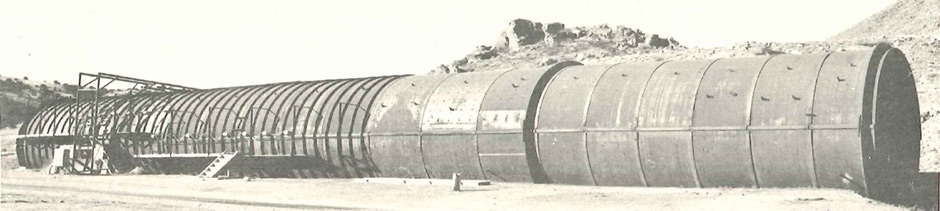
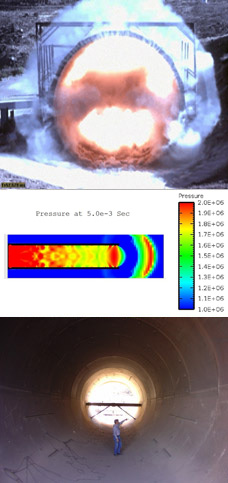
Large diameter shock tube testing provides a source that that can produce blast pressures and durations that are of interest to the safety and security communities. Building components and vehicles are likely targets. A blast exposure that would require thousands of pounds of explosives in an open arena test can be accomplished with about a hundred pounds of conventional explosives, or a fuel air mixture, using the EMRTC 20 foot diameter shock tube. Reflected pressures of up to 100 psi can be attained just outside the end of the tube.
4 foot and 2 foot diameter shock tubes offer a cost effective alternative when a large diameter blast source is not required. Common instrumentation options include: pressure gauges, strain gauges, accelerometers, displacement gauges and high speed visualization. The EMRTC can provide a wide range of support structure design and implementation.
EMRTC Shock Tube Experiments
- Experiments configurable to offer a wide range of tailored waveforms.
- Overpressures up to 200 psi.
- Durations of up to 200 ms and impulses of 350 psi-ms.
- EMRTC 20 ft diameter Shock Tube can accommodate large targets inside and outside of the tube.
- Smaller Items can be tested using either the EMRTC 4 ft diameter Shock Tube or 2 ft diameter scale model.
- Hydrocode and small scale modeling available for experiments where full scale testing is not an option.