Prevention of and Response to Suicide Bombing Incidents (PRSBI) Course Description
Technical Operations Level
Scope of Course
Field Laboratories
Academic Credit
Course Schedule
Performance Level
Course Application 
Technical Operations Level
- Five-day, train-the-trainer course format
- Sponsored by the Department of Homeland Security (DHS) Office of State and Local Government Coordination and Preparedness (SLGCP) formerly the Office for Domestic Preparedness
- Provides the knowledge and skill for developing policies, procedures, training and operational capabilities to deter, prevent, interdict, respond to, and mitigate the effects of a suicide bombing
- Designed for state and local law enforcement officers (including tactical teams), fire, emergency medical services, emergency management operations personnel and individuals in positions that would be responsible for responding to/planning for a suicide bombing threat/incident
- Course methodology includes classroom presentations, field laboratories, and practical exercises
Scope of Course
- Defining the Suicide Bombing Threat provides an historic overview of suicide bombing, characteristics of a suicide bomber, and how emergency organizations can disrupt a terrorist's ability to carry out a suicide bombing.
- Infrastructure Protection, Risk Management, and Critical Asset Assessment identifies the importance of conducting these assessments within a jurisdiction.
- Basic Explosives and Characteristics focuses on the energetic materials used by suicide bombers. Basic terms, concepts, and explosive characteristics are discussed in preparation for the field laboratories.
- Case Studies analyzes course concepts as applied to actual suicide bombing incidents.
- Suicide Bombing Devices familiarizes participants with suicide bombing improvised explosive devices (IEDs) and accessories used in the production or use of IEDs.
- Legal Issues in the Use of Deadly Force and Racial Profiling provides legal guidelines related to the use of force in the context of suicide bombing events.
- Threat Assessments provides worksheets that assist participants in accurately assessing local and regional threat levels. Participants develop a threat assessment of an adversary known to use suicide bombing as a tactic.
- Information Collection and Management, Indications, and Warnings familiarizes participants with data relating to techniques and processes for the collection, analysis, management and dissemination of counterterrorist protective information appropriate to their organizations and agencies.
- Vulnerability Assessments supplies information on the importance of conducting these assessments in order to develop scaled countermeasures appropriate to the threat. A practical exercise is included.
- Pre-Attack/Imminent Attack Countermeasures, Issues and Responses presents information, techniques, and practical examples of physical, procedural, staffing and operational countermeasures that can be implemented.
- Risk Analysis provides information on the importance of conducting a risk analysis based on asset, threat, and vulnerability assessments to assist in comparing and selecting effective countermeasures.
- Post-blast Issues and Responses provides policy guidance, as well as experience-based practical knowledge, on what to do in the aftermath of a suicide bombing.
Back to Top
Field Laboratories
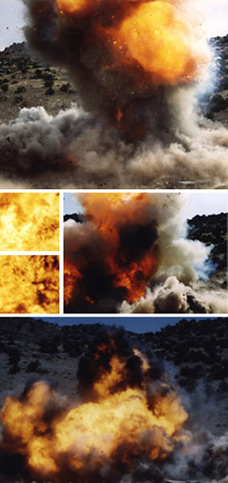
Three field laboratories allow students to observe and handle, when possible, explosives and their resulting damage. Sessions include:
- Suicide Bombing Devices Lab
- Package Bomb and Suicide Belt with Shrapnel Lab
- Vehicle Bomb Lab
- Full-scale Simulated Suicide Bombing Exercise
Note: Participants who pass the course final with a minimum score of 70 percent are certified as trainers and may earn academic credits from New Mexico Tech. Students interested in obtaining undergraduate or graduate level credit for the IRTB or PRSBI course should go to the following web address for more information IRTB and PRSBI Continuing Education or contact Leslie Griego at 1-866-476-9333, or email lgriego@emrtc.nmt.edu.
Back to Top
The four-hour performance level PRSBI course provides basic information on explosive and incendiary devices that could be used as terrorist weapons. Classroom topics include:
- Understanding the terrorist threat
- Improvised explosive devices (IEDs)
- Safety issues
- Departmental or agency policies to ensure compliance with local requirements
Contact your State Point of Contact or EMRTC to arrange a class in your area.