Incident Response to Terrorist Bombings (IRTB) Course Description
Technical Operations Level
Scope of Course
Field Laboratories
Academic Credit
Course Schedule
Course Application 
Performance Level
Technical/Operations Level
- Four-day, train-the-trainer course format
- Sponsored by the Department of Homeland Security (DHS), Office of State and Local Government Coordination and Preparedness (SLGCP) (formerly the Office for Domestic Preparedness)
- Designed for First Responders who may respond to incidents involving explosives
- Participants will be able to identify
- Commercial and military explosives
- Improvised explosive devices (IEDs)
- Readily available explosive formulations that terrorists have or could use
- Course methodology includes classroom presentations, field laboratories, and practical exercises
Scope of Course
- Course Introduction describes course background, purpose, content, manner of presentation and standards of behavior in the classroom, on the ranges and in the community.
- Terrorism and Energetic Materials identifies potential terrorist bombing targets and describes pre-attack indicators and tactics and techniques likely to be used during attacks on those targets.
- Introduction to Energetic Materials describes components, interactions and physical phenomena associated with explosive events.
- Recognition of Energetic Materials, Devices and Device Components recognizes explosive and incendiary materials, devices and device components.
- Responding to Pre-detonation Incidents specifies actions required to direct and participate in a safe and effective response to pre-detonation incidents.
- Responding to Post-detonation Incidents specifies actions required to direct and participate in a safe and effective response to a post-detonation incident.
- Responding to Special Situations describes how to adjust normal response policies, procedures and tactics during special situations to produce safe and effective operational responses.
- Case Study covers recent Weapons of Mass Destruction (WMD) incidents and lessons learned from the responding agencies.
- Field Laboratories identifies potential explosive mixtures, IEDs and materials and components that can be used to make an IED.
- Practical Exercises provide the opportunity to apply the skills and knowledge acquired during the course.
Back to Top
Field Laboratories
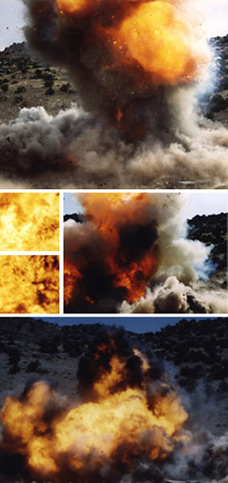
Three field laboratories allow students to observe and handle, when possible, explosives and to observe their resulting damage. Sessions include
- Initiation systems lab
- Improvised devices lab
- Small vs. large bombs lab
- Letter and briefcase/package bombs
- Full-scale vehicle bombs
Note: Participants who pass the course final with a minimum score of 70 percent are certified as trainers and may earn academic credits from New Mexico Tech. Students interested in obtaining undergraduate or graduate level credit for the IRTB or PRSBI course should go to the following web address for more information IRTB and PRSBI Continuing Education or contact Leslie Griego at 1-866-476-9333, or email lgriego@emrtc.nmt.edu.
Back to Top
The four hour performance level IRTB course provides basic information on explosive and incendiary devices that could be used as terrorist weapons. Classroom topics include:
- Understanding the terrorist threat
- Improvised explosive devices (IEDs)
- Safety issues
- Departmental or agency policies to ensure compliance with local requirements
Contact your State Point of Contact or EMRTC to arrange a class in your area.